I spent 8 days at Wat Pa Tam Wua, a Buddhist monastery in northern Thailand (near Mae Hong Son). Apart from a 30-day Sam Harris meditation course through an app that I did 10 years prior, I had no meditation experience. The monastery gave me more inner peace and clarity than I've felt before. It felt like my brain went back to its base state after years of phone notifications, emails, podcasts, and YouTube.
After I left I read Jamie Smart's The Little Book of Clarity and felt like I'd just lived his formula: "Clarity = Capacity − Contamination". I'd recommend anyone to try a monastery like this if you want to see what your mind is like without that contamination.
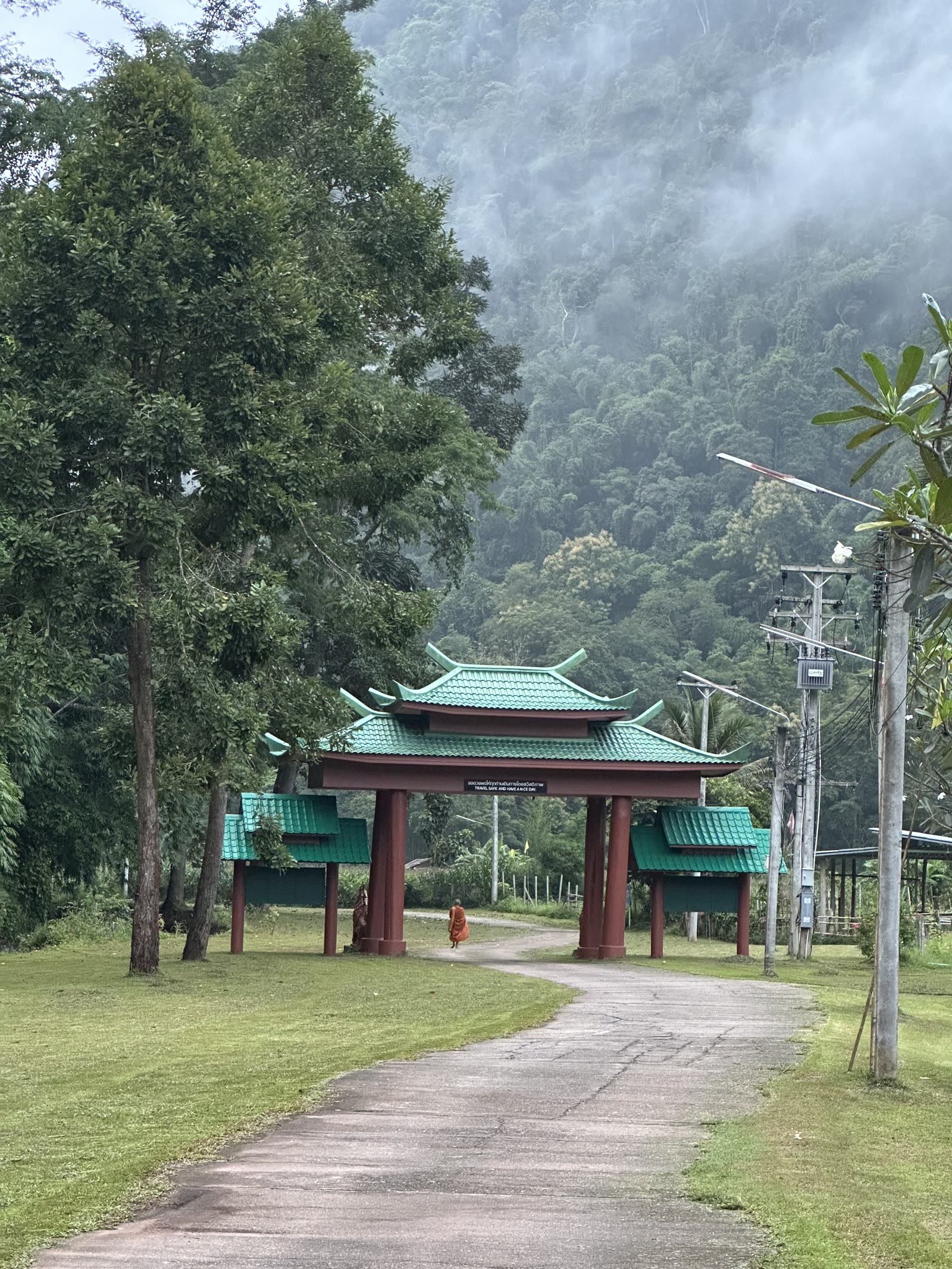
Monastery life
My brother currently lives in Chiang Mai, so after a few weeks with him we drove five hours along Route 1095 — almost 1000 curves (motion sickness pills recommended!) — to Wat Pa Tam Wua. You don't need to register in advance: check in any day between 6am and 4pm and stay 2 to 10 nights. Some people I met had been there for months. It's free and runs on donations. They give you white clothes, and there's a small shop for mosquito repellent, shower gel, etc.
The monastery was founded by Ajahn Luongta Saiyut. He spent decades as an ascetic forest monk meditating in mountain caves and wilderness across Thailand, then set up Wat Pa Tam Wua as a nature-immersed refuge for Thais and foreigners to learn meditation. He didn't give the Dhamma talks while I was there (Dhamma = the Buddhist teachings / the way things are), but he made himself available for questions. He seemed like a very happy (and probably enlightened) guy — he even spoke some German.
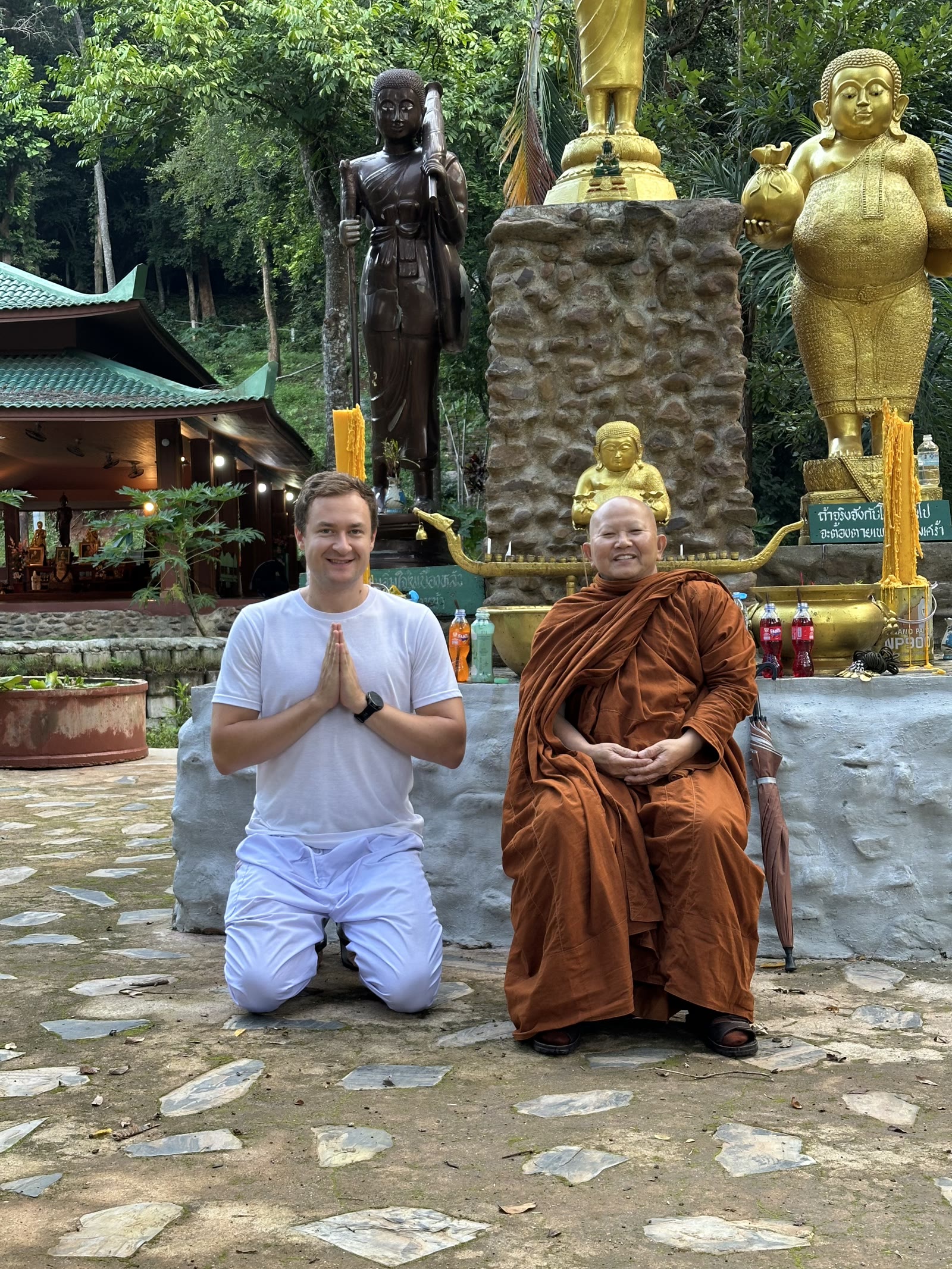
Monks follow 277 rules; guests follow only the Eight Precepts:
- abstinence from taking life
- abstinence from taking what is not given
- abstinence from unchastity
- abstinence from false speech
- abstinence from intoxicants which cause a careless frame of mind
- abstinence from taking food at the wrong time
- abstinence from dancing, music, visiting shows, flowers, make-up, the wearing of ornaments and decorations
- abstinence from a luxurious or high sleeping place
In practice the monastery is relaxed about guests: people eat at the cafe in the evening, and some used their phones throughout. I turned mine off for the stay, read a lot, took notes, didn't eat after noon, and mostly kept to myself. Strict silent Vipassana retreats ban talking, reading, and writing — that sounds much more intense. Not sure I'd manage it.
Here's the daily schedule:
You wake up early in a surreal setting: the monastery sits between two mountains with a small river running through it. It feels like being in an Avatar world.
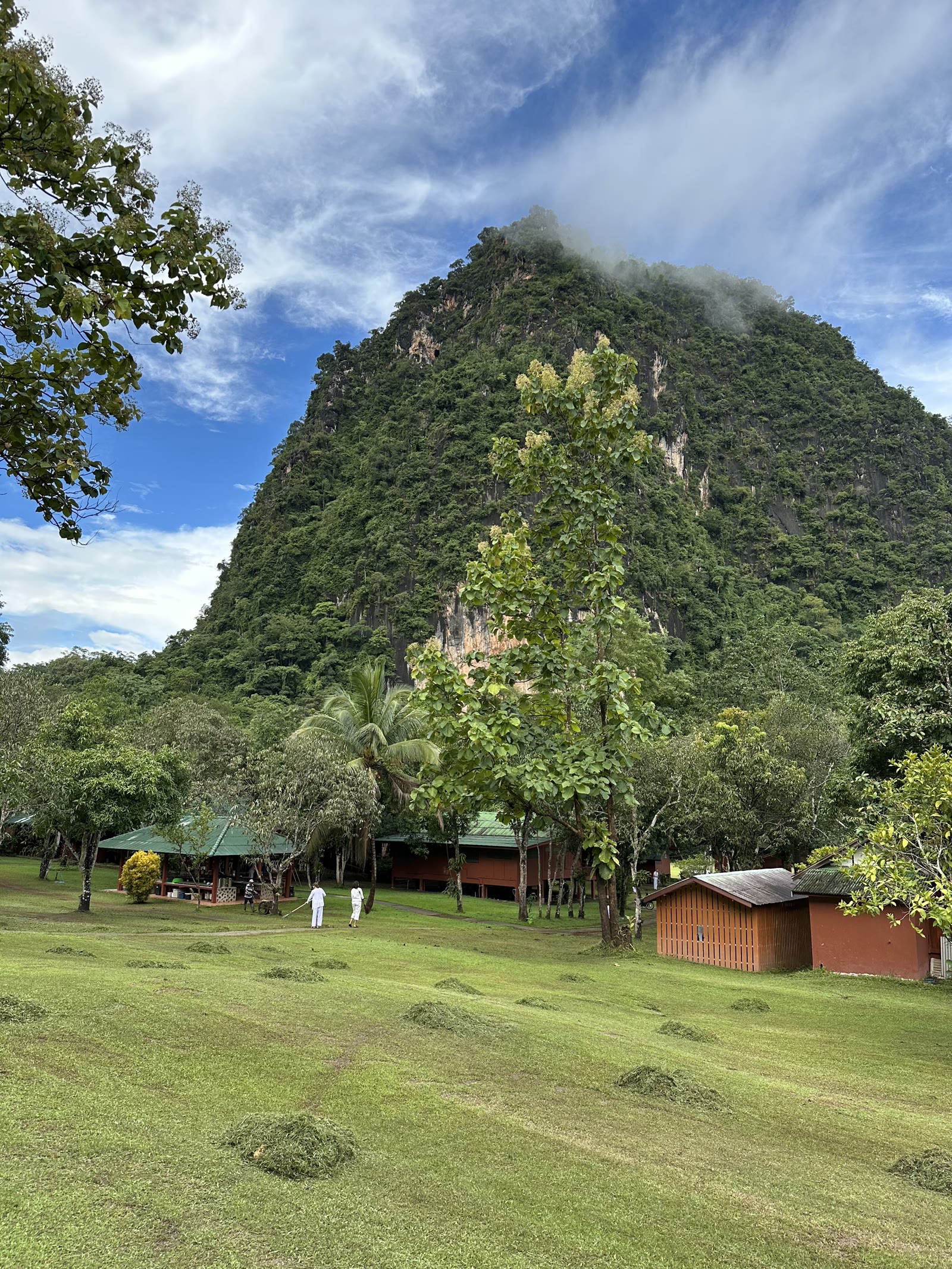
The day starts with solo meditation, though most people sleep through it and get up for the 6:30 rice offering. Monks aren't allowed to cook, store food overnight, or farm, so the offerings are a deal: monks provide spiritual guidance and an example of how to live; lay people provide the food — and in giving, practice generosity.
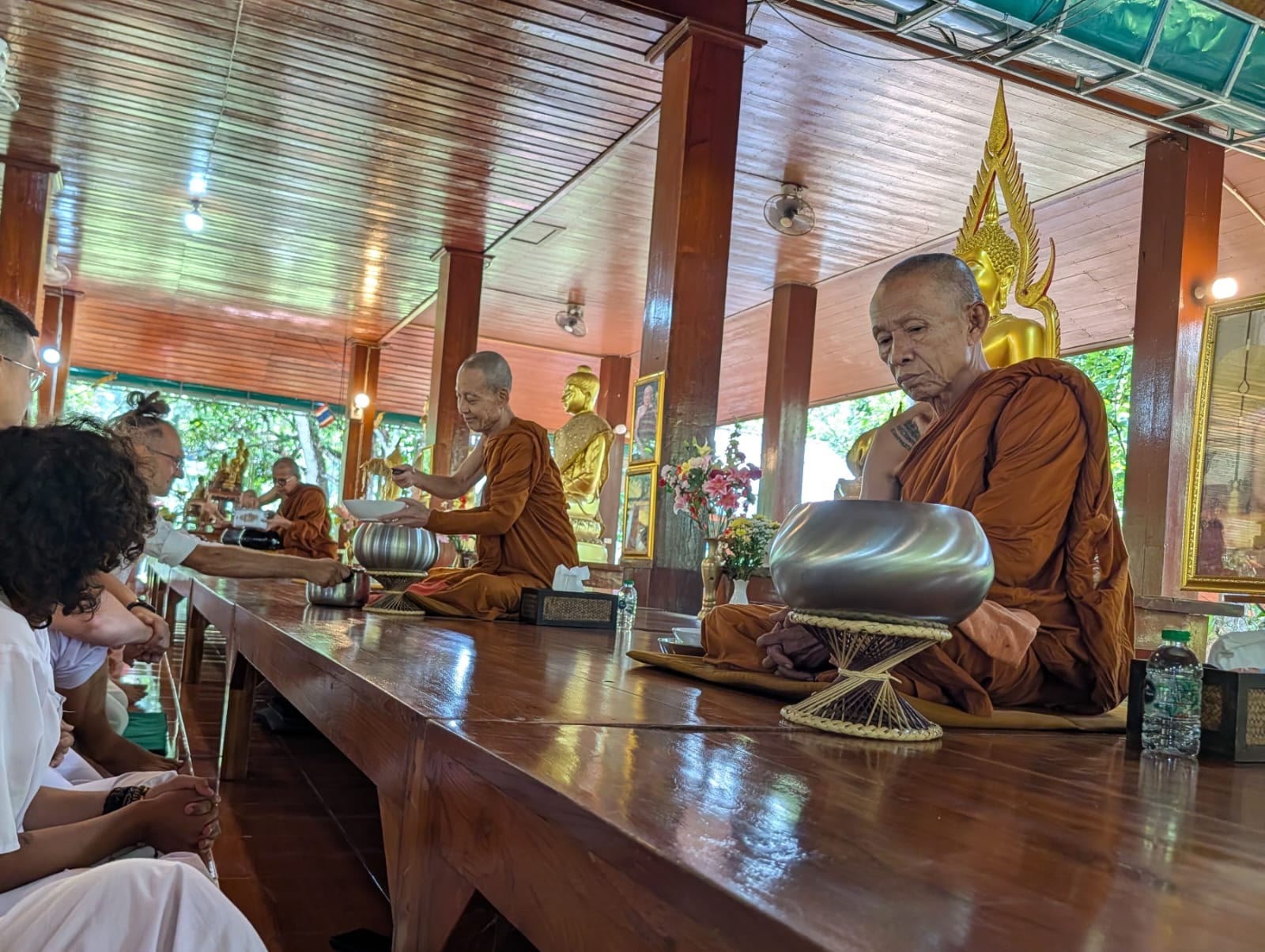
All meals are before noon. Some people fasted the whole time, which I'd like to try at some point.
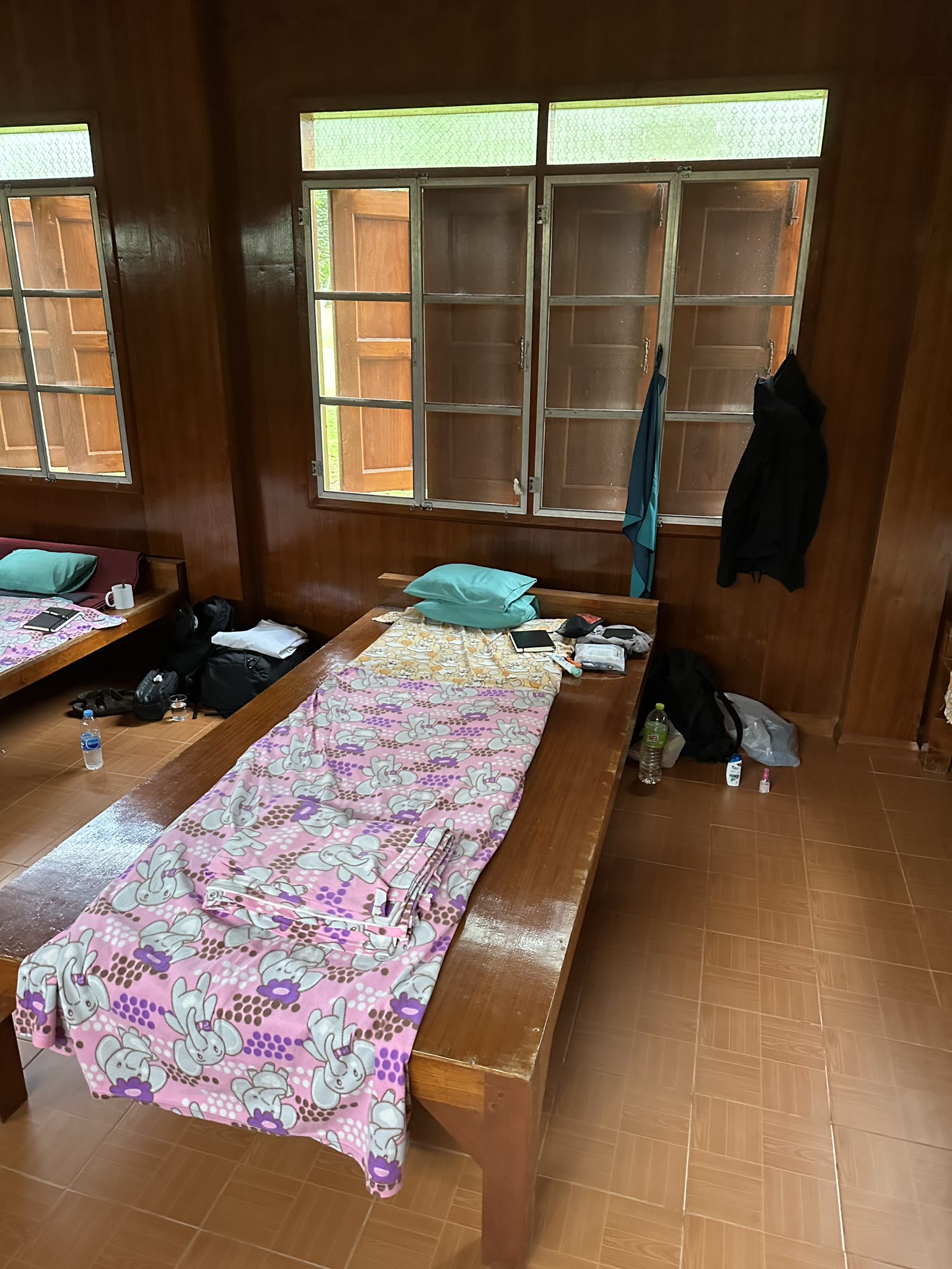
I stayed in a shared room on a wooden bed. Sleep was the hardest part — side sleeping on that surface is rough. Single rooms exist but I stayed in the shared one throughout my stay.
The 16:00 work session was one of the highlights of the day. You're not supposed to exercise, so physical labour feels good after hours of sitting. I started raking leaves, later helped set up a fruit garden, and toward the end ran introduction sessions for new arrivals.
Meditation
Morning and afternoon sessions share the same structure: a short Dhamma talk, 60min walking meditation, 40min sitting, 20min lying down. For beginners that's a good setup — two hours of pure sitting wouldn't work for most people.
There are two modes: Samatha (concentration) and Vipassana (insight). Samatha is sharpening the pencil; Vipassana is writing with it — still the mind first, then use that clarity to see how experience actually works.
Walking meditation takes getting used to. You cover about 1km in an hour, barefoot, eyes open, attending to sensation: wet ground touching your feet, sun on your skin, wind on your face. The aim is the "knower" state — the body moving like a robot while you just watch. You can't be knower and thinker at once. One way in is to watch the walking, then watch the mind knowing the walking, until it clicks that the knower knows the movement — not "you". You also can't force the knower to appear. It sounds quite confusing to talk and think about it. In the last few days I think I caught it for a few seconds at a time but it needs a lot more practice.
From Walk to be the Knower (monastery site · local copy): "The mind is just the watcher. The body moves and the mind watches. The body ceases to be Ours. This body moves but it is not us moving. True mindfulness arises. The mind awakens and sees that the physical form that is moving is not us."
Sitting and lying-down are mainly Samatha (concentration) meditation — just the breath. I can't sit on the floor for 40min yet, so I used a chair. I'll work on floor sitting over the next months; every meditation book recommends it. Even on a chair I got to some interesting mental states.
Evenings were my favourite: chanting in Pali (the Buddha's language), Thai, and English, then another 30min sit. The chanting is melodic and repeating the same phrases each day means you really get into it after a few nights. You start meditating just before dark; when you open your eyes again it's night. Sometimes it rained. Those evenings were hard to beat — and over six hours after the last meal, the mind is perfectly clear.1
On my last two nights I think I reached an absorption like what people call a Jhana state — I'm not sure enough of the term to claim the real thing. Each breath in felt like bright light through the body. You're grateful for the breath; just existing feels joyful. Each episode lasted maybe 5–10 minutes. You stop forcing focus on the breath, keep a little control of attention, and can still have thoughts (e.g. steer them toward visuals).
Another time the body felt like it was deforming. Hands on legs, then the distance between head and legs seemed to stretch and shrink, then body and mind collapsed to a single point. That was scary — I opened my eyes and stopped, and haven't managed to get to this state again. I thought you can only experience things like this on drugs, so it's interesting that meditation alone can get you there.
What worked for me technically: take 5–10 deep breaths and follow the air with your mind as it moves in through the nose and down into the body. Then stop controlling and watch the natural breath at one point on the nose. In and out usually hit slightly different spots for me; I tried to find one point both pass through. When thoughts appear, notice them and return to the breath. At home that happens constantly. A few days in at the monastery I almost never got pulled away. After 5–10 minutes of steady focus you drop into a deeper state where you don't have to chase the breath anymore — you just stay in a deep state of concentration. From there I tried focusing on visuals in the dark; that was hard, but that's how I reached these unique mental states.
Unique mental states aside, the everyday case for practice is simpler. One monk put it this way: we spend hours on the body — eating, brushing teeth, the gym — and almost no time on the mind. Meditation is gym for the mind. A few minutes morning or evening is already worth it.
A lot of what I was feeling only made sense once I read more about Buddhism. I'm still learning, so treat the next section as notes.
Buddhism
This was a Theravada monastery (mainly Southeast Asia; Mahayana is more Northeast Asia, and many other forms of Buddhism exist too).2 What I know here comes from a one-day course in Chiang Mai plus reading3 on site, so it's limited — happy to be corrected.
I treated Buddhism as a philosophy and practice rather than a religion, though in Thailand (and elsewhere) it clearly functions as one: temples, ritual, etc.
The Buddha lived around the 5th–6th century BC, and his core teaching is the Four Noble Truths:
- Dukkha: existence is bound up with suffering
- Samudaya: the cause is desire
- Nirodha: suffering can end
- Magga: the Noble Eightfold Path will lead to the end of suffering — grouped as wisdom (right view, right thought), morality (right speech, action, livelihood), and concentration (right effort, mindfulness, concentration)
The wisdom factors cover more than a single exercise. One part is contemplating the three Characteristics of Existence: impermanence (anicca), unsatisfactoriness (dukkha), and non-self (anattā). And even that sits inside a bigger split: there's ordinary wisdom — words and concepts — and a deeper knowing that only shows up in experience.
I asked various questions after Dhamma talks and to the Abbot, and the answers were never very concrete: more practice and that your body and mind are the teacher. The teaching monk kept returning to a story along these lines: a student is asked whether he believes the Buddha, says no, and the Buddha says good — don't believe me, investigate yourself. I couldn't find that exact exchange in the suttas; the closest official version is the Kalama Sutta, where the Buddha tells people not to take teachings on authority and to know for themselves.
The way you're supposed to know for yourself is practice. The Four Foundations of Mindfulness (Satipatthana) are mindfulness of body, feelings, mind, and mental qualities (dhamma). Most people start with the body — the breath — which predates the Buddha. He spent years there and reached enlightenment when he turned to mindfulness of the mind. The monk who taught us said the same about his own practice, and that more logical people often progress faster that way.
Takeaways
The mind is the only source of truth we actually have. Physics and "reality" still arrive through it. Spending time understanding how your mind works seems like a good use of time.
This is what I like most in the Buddhist framing. Your own body and mind are the teacher, and nobody can walk the path for you. That feels quite different from a lot of religions and philosophies, where the authority sits in a text, a church, or an abstract argument — here the instruction is to verify it in your own experience. That should land with a lot of technical people, and I wouldn't be surprised if this philosophy becomes more popular in the West. The closest Western philosophy is Stoicism — both aim to cool impulsive reactions, but a Stoic rewrites the judgment while a Buddhist watches the feeling pass without becoming it.
You don't need to accept every part of the Dhamma for the practice to be useful. Rebirth, kamma, and some of the broader world-view are harder to get behind.
I had a few other pushbacks at first. If the aim is less attachment, what happens to family and friends? If you watch emotions instead of diving into them, do you also lose joy? And if desire causes suffering, does that mean wanting things and having ambitions is off-limits? The way I make sense of it now: detachment isn't coldness — it's wanting good things for people without making your peace depend on them. You don't choose which feelings show up; you notice them, then choose how to act. Desire isn't banned — you just stop letting it control you.
I've also started reading more about the scientific side — neuroscience, consciousness research, and what meditation actually does in the brain. Why Buddhism Is True by Robert Wright is the one I'm reading now: evolutionary psychology meeting meditation. He's arguing that the "self" isn't a CEO — more like competing modules (craving, status, fear) with a stitched-together feeling of "I" after the fact. Mindfulness lets you see a craving module fire without obeying it. That maps cleanly onto knower vs thinker and no-self, just in different words.4
It'll be hard to keep the clarity and inner peace of my monastery stay during my day to day life. At home the phone is usually the first thing I touch in the morning and it stays with me all day. I listen to podcasts when I'm cycling or travelling around London, and for a long time I watched YouTube before sleeping — the last couple of months I've switched to a Kindle instead, which already helps. A few more changes I want to implement when I'm back in London:
- Inputs: less phone/laptop time; curate podcasts/YouTube/X intake
- Practice: sitting and walking meditation; yoga, sports, hot/cold therapy
- Food: earlier meals, maybe occasional fasts
- Life: a deep daily project, reading and writing, helping people, community
In the next months I want to learn more about neuroscience, brain-computer interfaces, and meditation. Please reach out if you have reading recommendations or you're into these topics.